
How we work
What actually happens, step by step
Ten steps from the first phone call to the first scheduled service. Your part is four of them, and three of those are just answering questions.
Phone call
We ask what you are trying to keep running, roughly how big the house is, whether you have natural gas at the property, and where you are. Ten minutes. If we are not the right fit — wrong size of job, outside our range — we will say so on this call rather than send somebody out.
- Who does it:
- Us
- Your part:
- Answer a few questions
Site visit and load assessment
We look at your electrical panel and service size, your gas meter and line, and every place a unit could legally sit given clearances from windows, doors, vents and the property line. We run the load calculation properly rather than estimating from square footage. Free, and there is no obligation attached to it.
- Who does it:
- Us, at your property
- Your part:
- Let us in, show us the panel
Written proposal
Itemised: equipment, transfer switch, electrical work, gas work, pad, permit and inspection. You can see what each part costs rather than one number. If a service upgrade is needed first, it is on there as its own line — not discovered halfway through.
- Who does it:
- Us
- Your part:
- Read it, ask questions, decide
Nothing happens until you sign this.
HOA approval, if your community requires it
Most master-planned communities in Fort Bend have architectural review for exterior mechanical equipment. We give you the placement drawing, equipment specifications and screening details your committee will ask for. You submit it, because HOAs deal with the homeowner, not the contractor.
- Who does it:
- You submit, we supply the drawings
- Your part:
- Submit to your HOA
Approval timelines are the HOA’s, not ours — start this early. Your HOA cannot ban a standby generator in Texas; see the HOA approval page.
Permit
We pull the electrical permit under our contractor license with whichever authority covers your address — your city, or the county if you are in unincorporated land. A Richmond or Katy mailing address does not reliably tell you which, and we confirm it before quoting so the schedule is real.
- Who does it:
- Us
- Your part:
- Nothing
Issued permit gates the install date.
Pad and placement
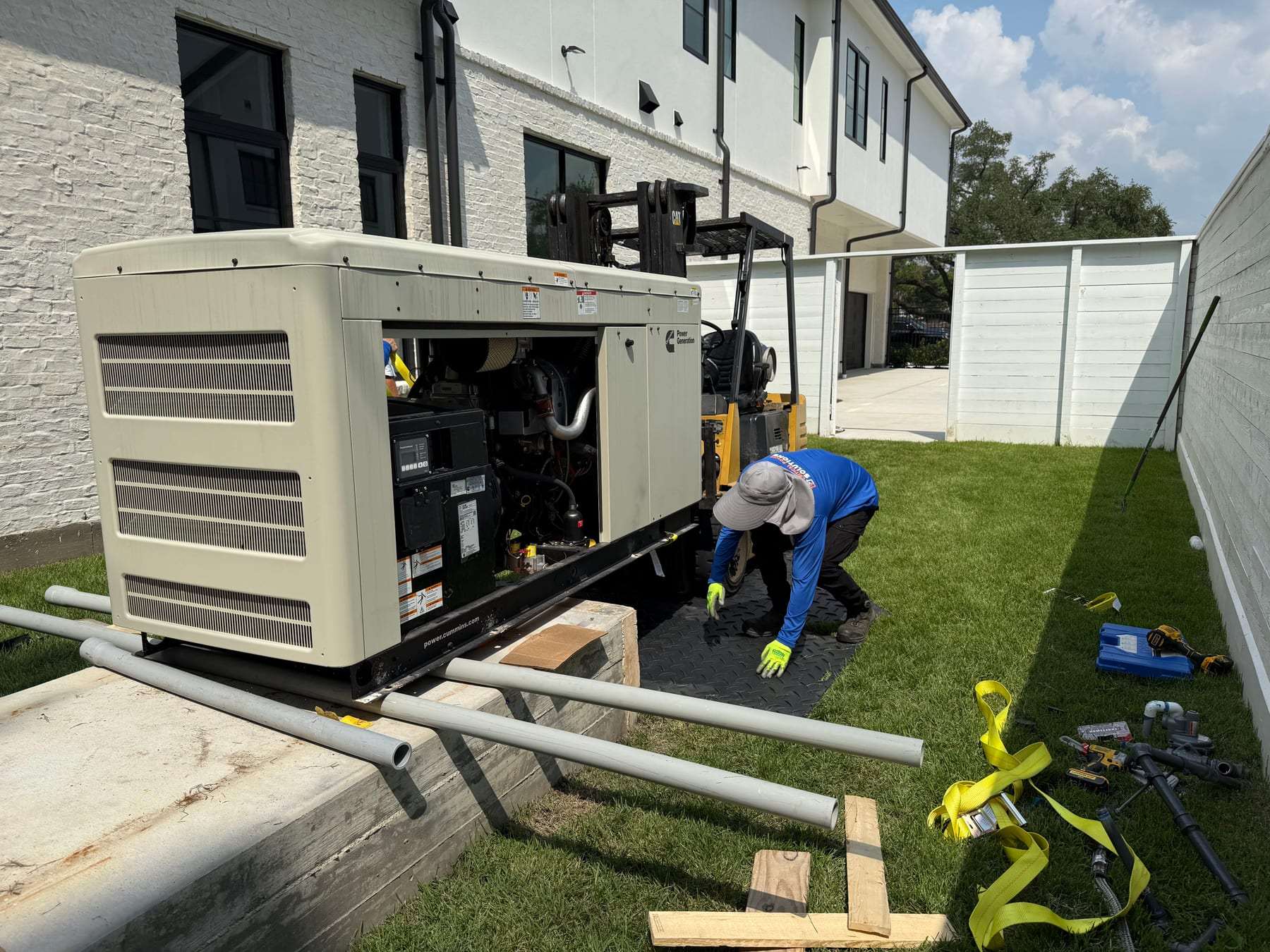
The pad goes in at the agreed location, set level and at an elevation that accounts for drainage — which matters more here than people expect, given how flat and low much of Fort Bend sits. On larger lots this is also when trenching happens, if the service is a distance from the house.
- Who does it:
- Us
- Your part:
- Nothing
Gas and electrical
The gas line is run and sized for this unit’s actual demand, not just connected to whatever was nearest — an undersized run is a leading reason a generator that passed inspection still struggles under load. The electrical run goes in and the automatic transfer switch is installed at your panel. Your power will be off for part of this.
- Who does it:
- Us
- Your part:
- Expect a short power interruption
Inspection
The authority that issued the permit inspects the work. We are there for it. If anything is flagged, we correct it and get it re-inspected; that is our problem to solve, not yours to chase.
- Who does it:
- Us — we meet the inspector
- Your part:
- Nothing
Inspector schedules this, not us.
Commissioning and handover
We start the unit, run it, and test the transfer under actual load so you see it happen. Then we walk you through the controls, show you how to read a fault code, set the weekly exercise schedule, and go through the maintenance intervals. Warranty registration is done at this point.
- Who does it:
- Us, with you there
- Your part:
- Half an hour of your time
Maintenance
A standby generator has an engine and needs servicing on schedule to stay under warranty and to start when it matters. Our GenWatch plans start at $35/month and we come to you; or you can call us when a service is due and pay per visit.
- Who does it:
- Us, on a schedule
- Your part:
- Nothing, if you are on a plan
Why we will not put a day count on this page
Plenty of contractors advertise a turnaround. The honest position is that two of the ten steps above are gated by people who do not work for us — your permitting authority and, if you have one, your HOA architectural committee. A number published here would be a promise we cannot keep in the week after a hurricane, which is exactly when it would matter to you.
What we will do is give you a realistic schedule with your written proposal, once we know your jurisdiction and your community. And we will tell you which step we are waiting on rather than going quiet.
The transfer switch is the part worth understanding
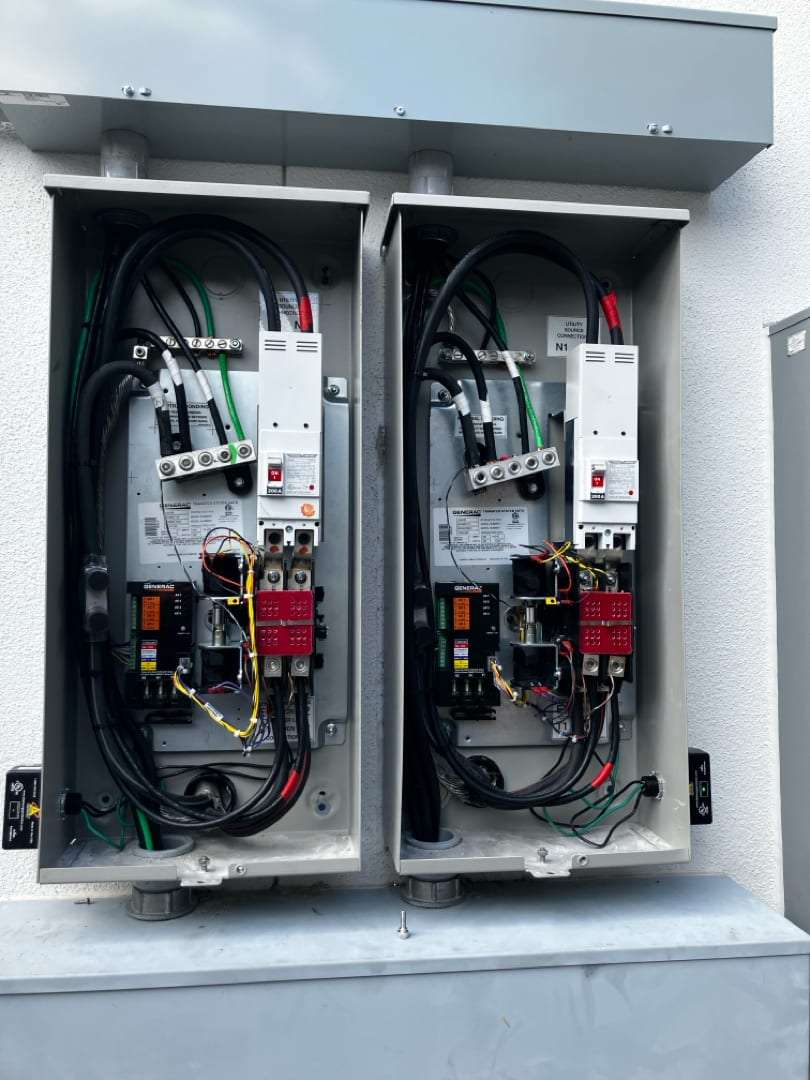
It is what separates your house from the grid when the generator runs — a safety device as much as a convenience one, because without proper transfer a running generator can backfeed the utility line and endanger anyone working on it.
It also decides what actually gets powered. A whole-home switch covers everything. An essential-circuits switch covers a defined subset for considerably less money. Which one makes sense comes out of the load calculation in step 2, and it is the single biggest lever on the price of the job.
Try the sizing calculator to see roughly where your house lands, or read what your HOA can and cannot require.
Common questions
- How long does the whole process take?
- It depends on two things we do not control: how quickly your permitting authority issues, and whether your HOA needs to approve placement first. The physical installation is the short part. We give you a realistic schedule with your proposal rather than a number on a website that hurricane season turns into a broken promise.
- Will my power be off?
- Yes, for part of the electrical work while the transfer switch is installed at your panel. We tell you beforehand roughly how long and we plan it around you where we can. It is hours, not days.
- Do I have to deal with the permit or the inspector?
- No. We pull the permit under our contractor license and we meet the inspector. If something is flagged, we correct it and get it re-inspected. The HOA submission is the one piece you handle, because HOAs deal with the homeowner rather than the contractor — and we give you the drawings and specifications to submit.
- What if my electrical service needs upgrading first?
- We find that on the site visit, and it appears as its own line on the written proposal so you can see what it costs before you commit. It is common on homes built before 200A service became standard. Discovering it mid-job is the outcome the site visit exists to prevent.
- Can I buy the generator myself and have you install it?
- Talk to us first. Manufacturer warranty on a new unit generally requires installation by an authorized dealer, and equipment bought elsewhere may not carry the same coverage. We would rather explain that up front than have you find out during a warranty claim.
- What happens if something goes wrong after installation?
- Call us. We installed it, we hold the dealer relationship with the manufacturer, and we file warranty claims on your behalf rather than handing you a phone number. See our warranty page for what the manufacturer covers and what we cover.
Get a straight answer on what it costs
Tell us about your home or building and we'll come out, size it properly and put a written number in front of you. No charge for the visit.
TECL #37583 · Kohler Certified · Generac Authorized Dealer ·BBB Accredited Business · Veteran & family owned